

Aaron Schulz
ISA Board Certified Master Arborist
Prescription Pruning Qualified - ISA Florida Chapter
This tree pruning blog series is designed to show how not all trees are created equally and that they require different decisions to be made based on the pruning objective. As homeowner insurance providers increase their demands for trees to be pruned away from structures, this series will be very informative for tree owners. In this series, we will take you through the initial call and appointment process and walk through how trees are supposed to be assessed and how the pruning recommendations we make align with both the client’s and a tree’s needs. There may even be some photos of how not to prune trees.
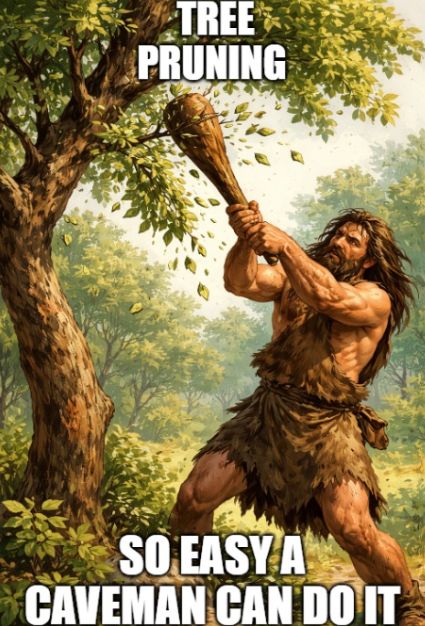
Tree pruning is the most common practice in the tree care industry. From the surface, pruning seems incredibly simple. What’s so hard about removing some branches? Despite pruning being the most common work completed on trees, it’s the least understood. When pruning is seen as simply “removing some branches” then quality and care go out of the window. The act of removing a branch may be simple (so easy a caveman can do it) but trees are dynamic organisms with responses, which makes the pre- and post- pruning process very complex.
|
|
When done correctly, pruning improves tree structure and increases stability. When done incorrectly, pruning can increase failure rate and decrease the life expectancy of your trees. At Oak Bros Tree Care, we focus on the “doing it correctly” part. It is important to recognize that trees are assets which increase social, environmental, and economic attributes of our day-to-day lives. To keep trees, and clients, happy you have to understand that we coexist with trees and that the pruning decisions one makes will impact tree health, structure, and subsequent life expectancy.
I have been in the arboricultural field for over 15 years and, even after all of this time, each tree presents a new structural problem that needs to be solved. No two sites or trees are exactly the same. To fully understand what needs to be pruned in a tree, we have to understand tree structure and a tree’s response to pruning decisions. The benefit of this knowledge is that we can anticipate how a tree will respond to specific pruning decisions and make sound pruning recommendations for our clients. Beyond managing plant health care and consulting, we champion the health of the urban forest. Our core responsibility as arborists is client education, ensuring every pruning recommendation is a positive, empowering step toward responsible tree stewardship. |
Initial Phone Call
At Oak Bros Tree Care, we train our staff to ask our clients a lot of questions. We are not asking them because we don’t know anything; we’re asking them because we are trying to learn more about why they are calling. The “why” helps our team understand the “what” in your pruning objective(s). “Objective” is the key word: if there is no defined objective at the end of our on-site appointment then no pruning is to be completed. Having done this for a long time, we have seen how other businesses approach pruning, and it’s often just “prune tree” on the estimate. That’s not an objective, that’s a request. It’s up to the pruning prescriber (Oak Bros’ Certified Arborists) to apply some critical thinking skills and develop a pruning specification. Basically, we formulate a pruning objective and specification based on your requests and the tree’s needs.
Here’s how a client’s purpose for calling translates into just a few words in our minds:
|
Client |
Arborist Interpretation |
|
“There are a lot of dead branches and I’m worried about them falling on my house” |
Reduce risk |
|
“I had a lot of trees planted a few years ago and I don’t know what to do with them” |
Improve structure |
|
“When it’s windy the branches over my house hit my roof” |
Provide clearance |
|
“My tree just looks like it’s overgrown” |
Improve structure, reduce density |
That last one, “my tree just looks like it’s overgrown”, may have you scratching your head and asking, “How does improving my tree’s structure make it not look overgrown?”. As it turns out, the best way to reduce density (what was formerly referred to as “thinning”) is to structurally prune a tree.
On-Site Appointment
After greeting you during our on-site appointment to discuss your pruning, we will ask, “Do you have any pruning requests or concerns before I assess your tree and provide my recommendations?”. Most of the time, we’re told to “get the tree away from my house”, “stop it from dropping dead branches”, “make it stop dropping leaves in my gutter”, or my personal favorite: “recommend what you know needs to be done”. The last one is my favorite because we know the client trusts us to provide sound recommendations because we are the subject matter experts. I’m going to let you in on a little secret: even though a client’s only request is for the tree to be raised over their house we’re still going to make additional recommendations based on what the tree needs. In all cases, our recommendation is going to be based on improving tree structure because we understand the role that structure plays in tree stability and subsequent longevity. Some clients respond to additional recommendations with, “I only want to take care of the clearance pruning” and that’s okay.
Some client pruning requests are too extreme for a tree to tolerate. In cases like this we make recommendations based on achieving a similar objective but not as extreme. Not all clients trust our less extreme recommendation. THAT’S OKAY! As I said before, our core responsibility as arborists is client education and, even though we are the subject matter experts, we are not going to change everyone’s mind. People don’t know what they don’t know and by bringing a sound pruning recommendation to their attention we’ve planted a seed that broadens their mindset on their tree.
To conclude this first blog in the pruning series I want to reiterate that while the act of pruning a tree looks simple, there’s a lot more to it. Not all contractors hired to prune trees know what they’re doing, and it shows. Correcting pruning mistakes is more time consuming and expensive. I’ve got over a decade of photos to prove it. When hiring a tree care provider, choose the one that exercises “care” and understands the pruning process from start to finish. There’s a reason the employees at Oak Bros Tree Care are trained to focus on tree structure and response whether they’re writing the pruning specification or completing the work. Choose right the first time. Choose Oak Bros Tree Care.
What’s Next?
The next blog in this series will focus on how our Certified Arborists assess tree structure to identify what needs to be pruned. Trees only appear to be made up of a trunk, branches, and leaves. In reality, they’re complex organisms and respond to pruning actions. I promise there will be more photos in the next blog. MANY more.