

Trees have a variety of insects that feed on them. Some are more noticeable than others, such as Japanese Beetle and Bagworm. To detect some of the most chronically damaging insects, such as Scales, you need a trained eye. If left unmanaged, Scales can cause chronic stress through the removal of sugar and cambium cells which may lead to symptoms such as early fall color, branch dieback, and eventual tree death. Knowing how to detect and successfully manage Scale infestations early is key to preventing chronic tree stress.
What are Scales, anyways? Scales are a group of small insects (8,000 known species). With a piercing-sucking mouthpart, Scales feed much differently than Japanese Beetle and Bagworm which have chewing mouthparts. Due to their small size and feeding style, Scales are very hard to detect. Tree owners often tend to notice Scale infestation symptoms when tree damage may be too advanced.
Scale insects are classified into three groups: Soft, Armored, and Felt. In Illinois we predominantly encounter soft and armored Scales. Soft Scales belong to the Coccidae family and have a soft, waxy body, and feed in phloem tissue. Armored Scales belong to the Diaspididae family and live beneath a waxy covering for protection.
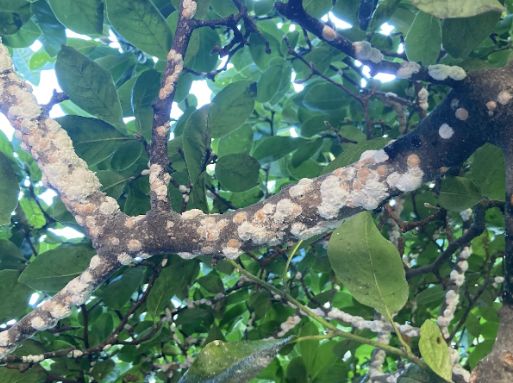
Magnolia Scale - maturing females
Soft and armored Scales both have similar life cycles. Soft Scales have one generation per year while armored Scales may have multiple, depending on weather conditions. Each female may produce 50 to over 3,000 eggs! Males are very small and fly around to find mates, as the females are stationary. Following mating, females will lay their eggs underneath their bodies or in a waxy fluff that may resemble cotton and subsequently die. Upon egg hatch “crawlers” wander around to find a place to feed on leaves or twigs, depending on the Scale species. The crawlers do not have a protective wax like covering at this lift stage, making them more vulnerable to control measures. Once the crawlers settle down they mostly stay stationary to feed, develop the wax like covering, and mature.
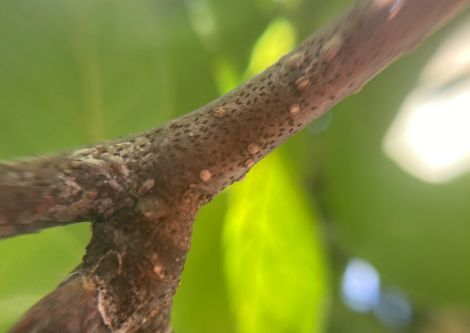
Magnolia Scale crawlers after egg hatch (red dots)
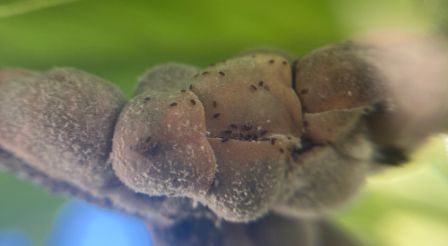
Magnolia Scale crawlers settled on twig (red dots)
All scale insects may all have the same type of mouth design but do not all feed in the same way. Soft Scales feed in phloem tissue, removing sugar from the tree. This causes them to secrete sugar from their bodies, referred to as honeydew. You may be more familiar with honeydew due to it causing a sticky substance on vehicles, driveways, or patio furniture. Eventually the honeydew will turn black, which is called Sooty Mold. The secretion of honeydew makes finding soft Scales a bit easier.
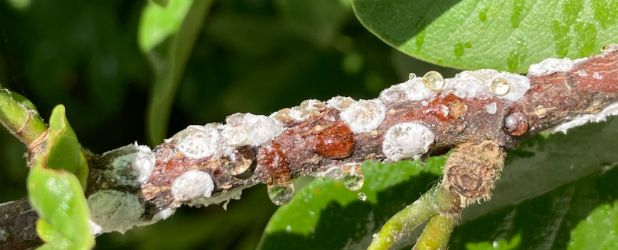
Magnolia Scale secreting honeydew
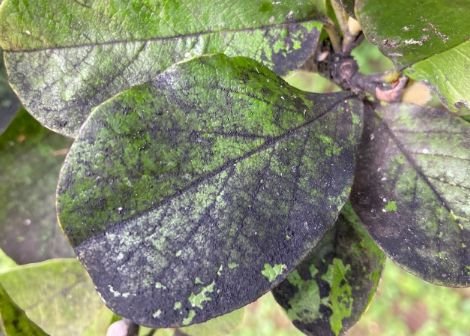
Sooty Mold on Magnolia leaves
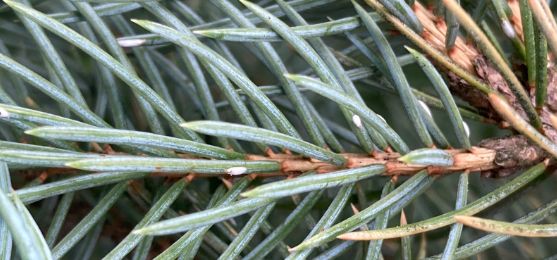
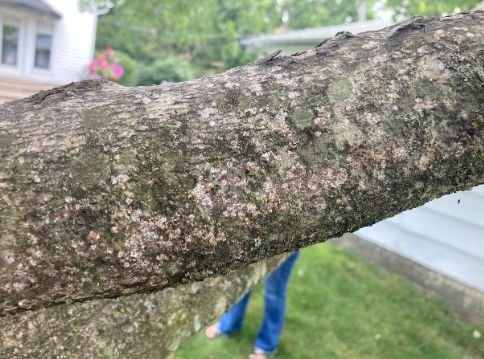
Armored Scales differ from Soft Scales in that they feed in the contents of cambium cells and do not produce honeydew. This makes finding the source of stress more difficult and requires extensive knowledge and trained eye of Scale identification.
Gloomy Scale on Red Maple
Pine Needle Scale (white ovals) on Blue Spruce
In moderate to severe Scale infestations, trees will exhibit symptoms of isolated early fall color, leaf yellowing (chlorosis), leaf browning, and or twig dieback. Using our expert eyes, hand lenses, and hand tools we are able to locate the source of the stress and develop a management plan for your trees.
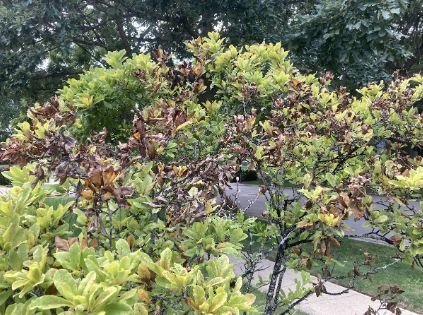
Star Magnolia twig dieback caused by Magnolia Scale
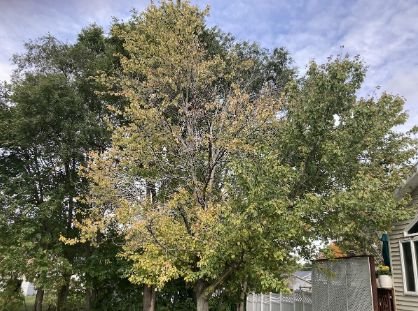
Red Maple early fall color caused by Gloomy Scale
Due to the protective waxy layer that Scale adults have and their manner of feeding, Scale infestations can be difficult to manage. Luckily, at Oak Bros Tree Care we are Bloomington-Normal’s leading experts in identifying and managing Scale insects. Other businesses attempt to make multiple Scale control applications using damaging predator insects, wasting your money, and not managing Scale infestation effectively. Using our knowledge of Scale life cycles we are able to formulate a management plan for your trees to successfully control Scale infestations and prevent further development. Through the use of systemic insecticides, insect growth regulators, and predatory insect preservation during periods of Scale vulnerability, we use a multi-pronged treatment plan to ensure the health of your trees.
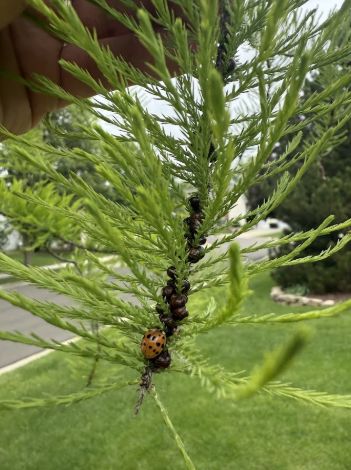
Asian Lady Beetle preying on Fletcher Scale of Baldcypress
When it comes to identifying and managing Scale populations in your landscape, Oak Bros are the leading experts who are trained in accurate diagnosis and predictable results.
Aaron Schulz
ISA Board Certified Master Arborist
Plant Health Care Director